
Ebook Download Will I Ever Be Free of You?: How to Navigate a High-Conflict Divorce from a Narcissist and Heal Your Family, by Dr. Karyl McBride Ph.D.
Your perception of this publication Will I Ever Be Free Of You?: How To Navigate A High-Conflict Divorce From A Narcissist And Heal Your Family, By Dr. Karyl McBride Ph.D. will lead you to acquire just what you specifically need. As one of the inspiring publications, this book will supply the existence of this leaded Will I Ever Be Free Of You?: How To Navigate A High-Conflict Divorce From A Narcissist And Heal Your Family, By Dr. Karyl McBride Ph.D. to collect. Even it is juts soft documents; it can be your collective documents in gadget and also various other gadget. The essential is that use this soft data book Will I Ever Be Free Of You?: How To Navigate A High-Conflict Divorce From A Narcissist And Heal Your Family, By Dr. Karyl McBride Ph.D. to check out and also take the benefits. It is what we imply as publication Will I Ever Be Free Of You?: How To Navigate A High-Conflict Divorce From A Narcissist And Heal Your Family, By Dr. Karyl McBride Ph.D. will certainly improve your thoughts and mind. After that, checking out publication will also improve your life high quality better by taking good action in balanced.
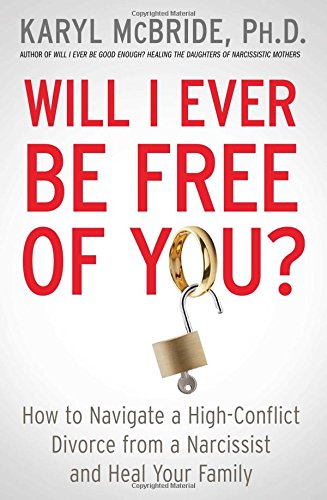
Will I Ever Be Free of You?: How to Navigate a High-Conflict Divorce from a Narcissist and Heal Your Family, by Dr. Karyl McBride Ph.D.

Ebook Download Will I Ever Be Free of You?: How to Navigate a High-Conflict Divorce from a Narcissist and Heal Your Family, by Dr. Karyl McBride Ph.D.
Some individuals might be chuckling when looking at you reviewing Will I Ever Be Free Of You?: How To Navigate A High-Conflict Divorce From A Narcissist And Heal Your Family, By Dr. Karyl McBride Ph.D. in your leisure. Some could be appreciated of you. And also some could desire be like you who have reading hobby. Just what concerning your personal feeling? Have you felt right? Reading Will I Ever Be Free Of You?: How To Navigate A High-Conflict Divorce From A Narcissist And Heal Your Family, By Dr. Karyl McBride Ph.D. is a demand and a leisure activity at once. This condition is the on that will certainly make you really feel that you have to check out. If you recognize are searching for guide qualified Will I Ever Be Free Of You?: How To Navigate A High-Conflict Divorce From A Narcissist And Heal Your Family, By Dr. Karyl McBride Ph.D. as the selection of reading, you can discover below.
By reading Will I Ever Be Free Of You?: How To Navigate A High-Conflict Divorce From A Narcissist And Heal Your Family, By Dr. Karyl McBride Ph.D., you can recognize the expertise and things more, not just regarding just what you obtain from people to individuals. Book Will I Ever Be Free Of You?: How To Navigate A High-Conflict Divorce From A Narcissist And Heal Your Family, By Dr. Karyl McBride Ph.D. will certainly be more relied on. As this Will I Ever Be Free Of You?: How To Navigate A High-Conflict Divorce From A Narcissist And Heal Your Family, By Dr. Karyl McBride Ph.D., it will actually offer you the smart idea to be successful. It is not just for you to be success in particular life; you can be effective in everything. The success can be started by understanding the basic expertise and do activities.
From the combination of expertise as well as activities, a person could boost their ability and capability. It will lead them to live and also work better. This is why, the students, workers, and even employers need to have reading habit for books. Any type of book Will I Ever Be Free Of You?: How To Navigate A High-Conflict Divorce From A Narcissist And Heal Your Family, By Dr. Karyl McBride Ph.D. will offer certain knowledge to take all advantages. This is exactly what this Will I Ever Be Free Of You?: How To Navigate A High-Conflict Divorce From A Narcissist And Heal Your Family, By Dr. Karyl McBride Ph.D. informs you. It will add more expertise of you to life and function far better. Will I Ever Be Free Of You?: How To Navigate A High-Conflict Divorce From A Narcissist And Heal Your Family, By Dr. Karyl McBride Ph.D., Try it as well as confirm it.
Based upon some experiences of lots of people, it remains in fact that reading this Will I Ever Be Free Of You?: How To Navigate A High-Conflict Divorce From A Narcissist And Heal Your Family, By Dr. Karyl McBride Ph.D. could help them making far better option and also give even more encounter. If you want to be one of them, let's purchase this book Will I Ever Be Free Of You?: How To Navigate A High-Conflict Divorce From A Narcissist And Heal Your Family, By Dr. Karyl McBride Ph.D. by downloading and install guide on link download in this website. You could get the soft data of this publication Will I Ever Be Free Of You?: How To Navigate A High-Conflict Divorce From A Narcissist And Heal Your Family, By Dr. Karyl McBride Ph.D. to download and deposit in your readily available digital devices. Just what are you waiting for? Allow get this publication Will I Ever Be Free Of You?: How To Navigate A High-Conflict Divorce From A Narcissist And Heal Your Family, By Dr. Karyl McBride Ph.D. online as well as read them in whenever and any type of location you will check out. It will not encumber you to bring heavy book Will I Ever Be Free Of You?: How To Navigate A High-Conflict Divorce From A Narcissist And Heal Your Family, By Dr. Karyl McBride Ph.D. inside of your bag.
The bestselling author of Will I Ever Be Good Enough?: Healing the Daughters of Narcissistic Mothers draws on her expertise in treating men, women, and children damaged by narcissists in this practical guide to divorce and its aftermath.
Narcissism—a personality disorder that goes beyond mere selfishness and vanity—is a prevalent cause of marital and family problems. Narcissists do not have the capacity to love, understand other people’s emotions, or feel empathy. They are grandiose in their need for praise and attention, they overestimate their abilities, and they diminish people around them with emotional abuse. Being in an intimate relationship with a narcissist destroys your hopes, dreams, and peace of mind and erodes your children’s emotional health and your finances.
Does this sound like what you have to deal with? If you ever look at your partner and wonder in despair if you will ever be free, the answer is yes, you can be.
A leading authority on narcissism, Dr. Karyl McBride offers proven therapeutic advice that will help you protect and nurture yourself and your children through your difficult divorce, from separating from your narcissistic partner and navigating the court system, where a narcissist can be especially destructive, to a restorative healing program of trauma recovery.
- Sales Rank: #15657 in Books
- Brand: Atria Books
- Published on: 2016-03-15
- Released on: 2016-03-15
- Original language: English
- Number of items: 1
- Dimensions: 8.37" h x .70" w x 5.50" l, .0 pounds
- Binding: Paperback
- 256 pages
- Atria Books
Review
"An important, groundbreaking book. Dr. McBride opens our eyes to these toxic individuals who damage their spouses, children, and inevitably the legal system. This innovative program will help families chart a course and create health and healing through the divorce process." (Renee Richker, MD, Child and Adolescent Psychiatry)
"Dr. McBride has put together a terrific, step-by-step guide for dealing with divorce from a narcissistic spouse. There is a huge need out there for this information, and Dr. McBride's long-term experience in therapeutic and legal settings makes her the perfect person to put it out there. I know I will be personally recommending this book for years to come." (W. Keith Campbell, Ph.D., co-author of THE NARCISSISM EPIDEMIC)
“As a family law attorney, I would give this book to certain clients with a highlighter and sticky notes. Enough said.” (S. Scott Lasher, Esq.)
"Karyl McBride's Will I Ever Be Free of You? is a smart, practical guide to a perplexing problem - severing your tie to a highly narcissistic partner. Full of good advice and moving examples, it is as readable as it is s sensible and helpful." (Terry Real, author of The New Rules of Marriage)
"Compact but thorough guide to successfully handling and surviving a divorce—if you’re married to a narcissist... Packed with useful advice... Proactive, goal-oriented, sound advice on how to heal, and how to move forward.... The author isn’t satisfied with helping the thousands of men and women whose lives have been damaged by narcissists and are involved in high-conflict divorces. She wants to help the children, too." (PsychCentral.com, Therapy Soup)
About the Author
Karyl McBride, Ph.D., is a licensed marriage and family therapist with more than thirty years of experience in public and private practice, specializing in treatment of trauma. She is a leading authority on narcissism and author of Will I Ever Be Good Enough? Healing the Daughters of Narcissistic Mothers. She is a contributing blogger for Psychology Today, Huffington Post, and her recent book was featured in the New York Times book club. Dr. McBride can also be found online at WillIEverBeGoodEnough.com, KarylMcBridePhD.com, and Facebook.com/DrKarylMcBride.
Excerpt. © Reprinted by permission. All rights reserved.
Will I Ever Be Free of You? CHAPTER ONE AM I IN A RELATIONSHIP WITH A NARCISSIST? HOW DO I KNOW?
When Ellen entered her first therapy session with me, she held a card in her hand that she’d printed out from Someecards.com. Without speaking, she handed it to me. It read, “We divorced for religious reasons. My partner thought he was God and I didn’t.” While I smiled at the humor, it gave me a good sense about what she would tell me in her story.
When Mark and Ellen first met, Ellen felt caught up in a whirlwind of excitement. Mark was charming, witty, and seductive. Ellen believed that what she and Mark felt for each other was true love. She didn’t realize until after they’d married and had children that Mark’s charm was that of an artful narcissist. Despite his initial showy displays of love, Mark cared only about himself and consistently manipulated others to get his own needs met. He emotionally abused Ellen and their children. When Ellen decided that she had had enough and filed for divorce, Mark was appalled. He could not believe that Ellen would abandon him and ruin his life. Mark saw himself as the victim.
Unwilling to compromise, unable to see things from any perspective other than his own, consistently angry and vindictive, Mark created havoc for Ellen through the divorce, lashed out during each phase of the proceedings, and had excuses for even his most egregious behavior, blaming others—especially Ellen—for his actions. He never thought twice about using his children as pawns. The judge got increasingly frustrated as Mark and Ellen showed up in court again and again.
When a divorcing couple is made up of one narcissist and one reasonably normal person, the narcissistic spouse can single-handedly create all kinds of conflict. The narcissist’s actions cause the “normal” spouse to go into defense mode—especially when children are involved. To outsiders, it looks like a fight between equals, but what is really happening is that the normal spouse is trying to protect the children from a bully. Many people do not recognize the qualities of narcissism, even when they are involved with a narcissist.
A common perception among divorce lawyers, therapists, parenting-time evaluators, judges, and other professionals is that, whenever you have a “high-conflict” divorce, both parties are responsible for the conflict. Many professionals assume that difficult, drawn-out custody battles are caused by two parents who are each stubborn, selfish, and perhaps a bit crazy. As Michael Friedman wrote in an article for The American Journal of Family Therapy, “The concept has even entered into what might be called family court folk wisdom: we say that Mother Teresa does not marry Attila the Hun or that it takes two to tango.”1
People use the label narcissist loosely, typically to indicate someone who is vain and selfish, but the personality disorder is precisely defined and has been studied by mental health professionals who have identified the traits of narcissists. How do you recognize someone who is a narcissist, as opposed to someone who has a healthy self-respect or even someone who is disagreeably arrogant, but not an actual narcissist?
Could This Be My Partner (or My Ex)?
The term narcissism comes from the Greek myth of Narcissus, a handsome young man who believed himself to be better and more beautiful than everyone else and who fell in love with his own reflection in a pool of water. Whenever he reached out to capture this vision of beauty, however, he touched the water and shattered the reflection. Even so, he could not tear himself away and lost all interest in food, rest, and normal life. Gradually, he lost the strength and the beauty that had made him so appealing and died while gazing at his reflection. His unhealthy self-love was a curse. Sigmund Freud used this myth to describe a psychological disorder—a disease of self-love—that he saw in some of his clients.2
The American Psychiatric Association (APA) classifies mental disorders according to their symptoms in The Diagnostic and Statistical Manual of Mental Disorders (DSM). The DSM includes narcissism with personality disorders that lead to dramatic, emotional, or erratic behavior, such as borderline personality disorder (BPD) and histrionic personality disorder (HPD). These personality disorders have a lot of “comorbidity,” meaning that someone can have more than one of them at once. The nine traits listed below from the DSM define the narcissistic personality:
1. Has a grandiose sense of self-importance, e.g., exaggerates achievements and talents, and expects to be recognized as superior without commensurate achievements.
2. Is preoccupied with fantasies of unlimited success, power, brilliance, beauty, or ideal love.
3. Believes that he or she is “special” and unique and can only be understood by, or should associate with, other special or high-status people (or institutions).
4. Requires excessive admiration.
5. Has a sense of entitlement, i.e., unreasonable expectations of especially favorable treatment or automatic compliance with his or her expectations.
6. Is interpersonally exploitative, i.e., takes advantage of others to achieve his or her own ends.
7. Lacks empathy: is unwilling to recognize or identify with the feelings and needs of others.
8. Is often envious of others or believes that others are envious of him or her.
9. Shows arrogance, haughty behaviors or attitudes.3
Narcissism is a spectrum disorder, which means it ranges from a few narcissistic traits to full-blown narcissistic personality disorder (NPD). How common is narcissism? The American Psychiatric Association estimates that 2 to 16 percent of the people who are being treated by a mental health professional suffer from it, and it manifests in less than 1 percent of the general population.4 In other words, the APA thinks it’s rare. On the other hand, Jean Twenge and W. Keith Campbell, authors of The Narcissism Epidemic: Living in the Age of Entitlement, state, “Nearly 1 out of 10 Americans in their twenties, and 1 out of 16 of those of all ages, has experienced symptoms of NPD.”5 Twenge and Campbell believe that we are living in a narcissistic culture and that the incidence of narcissism is increasing.
I believe the truth lies somewhere between these two points of view. We all have some narcissistic traits and can occasionally behave in a narcissistic way. That does not mean we are narcissists. Given that narcissists generally do not seek treatment, I believe that narcissism is much more common than statistics would indicate. My research and clinical practice also support this view.
Let’s spend some time getting to know the nine traits of narcissism by looking at examples of how they present themselves in love relationships. Remember, this is a spectrum disorder. The more of these traits a narcissist has, the more heartbreak he or she creates for the people in relationships with them.
The narcissistic personality:
1. Grandiose sense of self-importance without commensurate achievements. Example: The partner whose attitude is “When I say ‘Jump!’ you say ‘How high?’ ” Jackie was the breadwinner for her family, which included her husband, a stay-at-home dad, and two children. Jackie expected the family to organize all their activities around her. She was a finance executive for a car dealership, but to hear her talk, she owned and ran the company. They would be bankrupt without her! Jackie reminded her family constantly how smart she was. She clearly felt that others were beneath her.
2. Fantasies of unlimited success, power, brilliance, beauty, or ideal love. Example: The partner who constantly obsesses about status symbols. When Paul and Vicky went on vacation, Paul would always call local real estate agents, pretending to be in the market for a new or vacation home. He would present himself as a wealthy investor and insist that he needed a real estate agent sophisticated and connected enough to screen properties for him, so that he would see only the best of the best. While his income was middle-class, he would say things like “We really need a property that has a private landing strip, or at least room to add one. I travel a ridiculous amount, and I prefer to fly my own plane when I can. It’s just more convenient.” Vicky felt embarrassed to be pulled into this kind of lie and ashamed to be deceiving the real estate agents.
3. Belief that he or she is special. Example: The partner who regardless of income has to have the best divorce attorney in town. When seeking professionals to help with a divorce, such as evaluators and therapists for the children, the partner can only hire experts with PhDs who have studied at prestigious universities. If the judge does not rule in the narcissist partner’s favor, that partner decides the judge is stupid and probably won’t follow the court’s orders. I recently observed a woman yelling at a judge, “You are just ridiculous. I am going to get a new judge!” She seemed to think this was as easy as exchanging a pair of shoes and was surprised when security removed her from the courtroom.
4. Requires excessive admiration. Example: The partner who is so needy that he or she solicits admiration all the time. My client Tasha said, “Whenever we were going anywhere special, my partner Julia would always be the last one dressed. The whole family would be gathered in the hall, impatient and ready to go. Then Julia would make her entrance, coming down the stairs, preening and turning. She was waiting for everyone to go ‘Oooooooooh’ and ‘Aaaaaaaaah’ and ‘Mama, you’re so gorgeous.’ The kids and I would go over-the-top admiring her. We knew we weren’t leaving the house until she got the admiration she wanted.”
5. Has a sense of entitlement and expects automatic compliance of others. Example: Marcy felt she was entitled to pay less and demand more from the law firm she had retained. She refused to talk with the paralegals, always demanding to speak with “the attorney I am paying so much money to.” If her hysterical demands were not met instantly, Marcy would threaten to change attorneys. Her favorite saying to her friends and family was “I will demand attention and be heard immediately, and if you don’t believe me, just watch.” Marcy’s lawyer dumped her right before the proceedings began.
6. Is interpersonally exploitative and takes advantage of others. Example: The father who uses his children for his own ends. After Jeff and Heather got divorced, Jeff treated his daughter like an accessory. He realized that “there is nothing that makes a single man more attractive to women than walking around looking like a devoted father to his three-year-old daughter.” He insisted that she dress in clothes that made her look upper-class and took her out to late-night dinners at restaurants. Once, when she became ill while visiting with him, he checked into a hotel so that the hotel staff would have to clean up after her vomiting. Jeff felt that he should not have to do this.
7. Lacks empathy. Example: The person who views any situation through the lens of what it means to him or her. Peter came home and said to his wife, “You know how my secretary has that bad breast-cancer gene? The one that means she has to take time off from work every four months to have screenings? Well, right now, when we are under so much stress in the office, she’s finally been diagnosed with breast cancer. I can’t believe this is happening to me. She was also rattling on today about how worried she is about her kids and how they will handle this . . . hinting she might need more time off work. My business cannot handle this right now!”
8. Is often envious or believes others are envious of him or her. Example: The partner who cannot enjoy her husband’s success. Brian was a new partner at a law firm and had just won a complicated and hard-fought trial. The law firm arranged a party to celebrate this victory and to thank Brian for his successful work. Brian wanted his wife, Beth, to attend the party and celebrate with him. Beth pretended that she would go and “acted” excited, but right before they left for the party, she decided to stay home because “I have better things to do!” She told Brian as he was walking out the door, “I think you won that case because I was listening to your whining every night. You couldn’t have done it without me. I really don’t have the time in my schedule to do that for you.” Brian’s excitement and pride in his work was blown to bits as he slowly drove to the party alone.
9. Shows arrogance. Example: The partner who is not particularly engaged with his child’s accomplishments but wants to take all the credit for them. Jake attended a parent-teacher conference with his ex-wife and eight-year-old son, Mick. Mick was doing well in math, and his teacher was showing his papers and test scores to his parents, clearly wanting little Mick to have the lovely experience of being praised by a teacher in front of his parents. Jake interrupted the teacher abruptly and announced, “I can see where he gets his brilliance! I was always a star in mathematics as well and in fact won a trip to an academic festival when I was much younger than Mick. It is also why I am doing so well in my engineering career. Yup, this kid gets his smarts from his dad. Nice going, son.”
These nine traits describe why narcissists cannot love. They place primary importance on “what you can do for me” and expend a lot of energy on appearances. In a relationship with a narcissist, you will eventually realize that this person does not see the real you. You are the person’s object to be manipulated for his or her own goals and needs.
My client Todd struggled to keep his voice steady as he said, “It is just so hard for me to realize that my wife is not capable of love. Our whole relationship was a farce. How could I have not seen it? It hurts me so much for our children as well. She can really never be the mother they need. None of our emotional needs were met, and I am just now understanding this.”
Suzie was exasperated as she revealed, “I found out rather quickly that my husband would exaggerate his stories to make them sound better. He was often obnoxious to others, particularly those in the service industry. There seemed to be something missing in him. There wasn’t a soul of deepness to him. He would fake this charming cuteness. I guess I should have figured this out sooner, like on the day of our wedding, when he was showing his actor side. In the wedding ceremony, I was looking at him and his body was turned to face all the people out in the audience. I whispered to him that he was supposed to be looking at me. He thought he was on a damn stage.”
Is It Narcissism or Something Else?
If you have looked at the traits and examples above and said, “That’s my partner and that’s my life,” then your partner likely has narcissistic traits or maybe even full-blown narcissistic personality disorder. You will probably never get an official diagnosis because your partner likely won’t seek treatment. Even if you are in therapy, your therapist will only be able to make a secondhand diagnosis based on your reports about how your partner behaves.
People who are sociopathic, psychopathic, or abusive are extreme examples of narcissists. Other people who are emotionally limited may not be narcissistic. Asperger’s syndrome, for instance, may be confused with narcissism because people with Asperger’s are not as sensitive as normal people to emotional cues, but they do not mean to hurt or manipulate others. Narcissists generally know when they are hurting someone else and don’t care.
In a blog post titled “Just Listen—Don’t Confuse a Narcissist with Asperger’s Syndrome,” Dr. Mark Gouldston told a story about a father, a successful entrepreneur, who came with his fourteen-year-old daughter to Mark’s office. When the daughter became distressed, her father looked bewildered, then started to cry. “My little girl is in awful pain and I think I somehow caused it. But I love her and that’s the last thing I would ever want to do.”6
The father had Asperger-like features but was sincerely upset at his daughter’s sadness. He empathized, something narcissists are not capable of doing. Also, he perceived that he was responsible for her distress, which upset him. He felt accountable, which narcissists do not feel.
We will hear more stories as we go, but let’s take some time to look at your story. I’m going to ask some questions about you, your partner, your relationship, and your children. As you go through this list, put a check mark next to any question you answer yes. The more questions you check, the more likely it is that your partner falls somewhere on the narcissism spectrum—maybe even has a full-blown narcissistic personality disorder.
Is Your Partner a Narcissist?
1. When something goes wrong, does your partner blame everyone but himself or herself?
2. Does your partner refuse to be accountable for his or her bad behavior? (For example, “You made me so mad that I couldn’t help . . .”)
3. Does your partner believe he or she is always right?
4. Is your partner unable to tune in to your feelings or your children’s feelings?
5. Does your partner seem more concerned about how your behavior or your children’s behavior reflects on him or her than on understanding and accepting who you and the kids are as people?
6. Does your partner seem to be out of touch with his or her own feelings or seem to deny them?
7. Does your partner carry grudges against you and others?
8. Is it all about your partner and his/her money, time, parenting time, property, and wishes/demands?
9. Does your partner seem unwilling to listen to you and to hear your concerns?
10. Is your partner constantly telling you what to do?
11. Does your partner make you feel “not good enough”? Have your partner’s constant put-downs caused you to internalize this message?
12. Does your partner never ask about you, your day, or your feelings, even in passing?
13. Does your partner need to go on and on about how great he or she is and how pathetic you are?
14. Does your partner lie?
15. Does your partner manipulate?
16. Does your partner tell different people different stories about the same event, spinning the story so that he or she looks good?
17. When your partner talks about his or her kids, is it about what the kids do rather than who they are?
18. Are the children uncomfortable with your partner, love your partner, but at the same time are reluctant to spend time with him or her?
19. Have you come to realize that the kids protect themselves by not sharing their feelings with your partner?
20. Does your partner mistrust everyone?
21. Are the kids always trying to gain your partner’s love and approval?
22. Has your partner spent minimal time with the children?
23. Does your partner typically skip the children’s events if he or she does not have an interest in that particular activity or does not value it?
24. Does your partner push the children to be involved in activities that your partner likes or values and discourage or forbid them from pursuing activities that your partner does not value?
25. Have others in your life said that something is different or strange about your partner?
26. Does your partner take advantage of other people?
27. Is your partner all about power and control, pursuing power at all costs?
28. Is your partner all about image and how things look to others?
29. Does your partner seem to have no value system, no fixed idea of right and wrong for his or her behavior?
30. After the divorce, does your partner still want to exploit you? Or has your partner never calmed down?
31. When you try to discuss your life issues with your partner, does he or she change the subject so that you end up talking about your partner’s issues?
32. When you describe your feelings, does your partner try to top your feelings with his or her own stories?
33. Does your partner act jealous of you?
34. Does your partner lack empathy?
35. Does your partner only support things that reflect well on him or her?
36. Have you consistently felt a lack of emotional closeness with your partner?
37. Have you consistently questioned if your partner loves you?
38. Does your partner do considerate things for you only when others are around to witness that good behavior?
39. When something difficult happens in your life (for instance, an accident, illness, a divorce in your family or circle of friends), does your partner react with immediate concern about how it will affect him or her rather than with concern for you?
40. Is your partner overly conscious of what others think?
41. Do you feel used by your partner?
42. Do you feel responsible for your partner’s ailments or sicknesses?
43. Do you feel that your partner does not accept you?
44. Is your partner critical and judgmental of you and others?
45. Do you feel that your partner does not know and value the real you and does not want to know the real you?
46. Does your partner act as if the world should revolve around him or her?
47. Does your partner appear phony to you?
48. Does your partner swing from grandiosity to a depressed mood?
49. Does your partner try to compete with you?
50. Does your partner always have to have things his or her way?
As these questions show, narcissists are good at training you to doubt yourself. You may have come to feel that you are not good enough, and all bad outcomes are your fault, and even been conned into believing that you deserve nothing better.
Jeff, a client who had been partnered with Larry for eighteen years, described walking down the street and noticing a stylish young man coming in his direction, a man with a good haircut in some well-tailored pants. Jeff admired the man’s subtle and thoughtful style. Then he realized that he was looking at his own reflection in a downtown store window. Larry had made him feel so ugly—his sense of self was so distorted—that he did not recognize himself.
Going through this checklist may be a shocking reality check for you as you realize that you have been duped, manipulated, or taken advantage of by a narcissist. Maybe you read the lists of narcissistic qualities in this chapter with a sinking feeling. The lists make a narcissist’s traits suddenly seem so obvious that it is easy to get upset and think that you brought this on yourself, that you should have known. You may be furious as you remember the red flags that you chose to ignore. But give yourself a break. You’re a good person. You just got deceived by someone who is practiced at deception. You are better, you deserve better, and you will get better.
There Is a Better Way
Recently, I logged on to Amazon.com to buy some hanging file folders for my office. I was trying to decide between three different options and decided to look at the customer reviews. You’ll understand why this review caught my eye:
If you’re getting divorced you need these [file folders]. These will help you organize your soul-crushing divorce into easy-to-find packets of misery when you have to go to court to battle your insane drug-addicted ex (again) over custody of your two traumatized children. Don’t put your pain in a pile! Let these hanging file folders neatly catalog the narrative of how you undid the worst mistake you’ve ever made. Your lawyer will thank you.7
If your partner is a narcissist, your life may feel like a train wreck right now, but you can get through this stage of your life. You can emerge stronger on the other side, even though you may need those file folders! But, first, we have to stay in this difficult place a little bit longer to understand how you got to where you are. Why did the narcissist target you? Why did you fall for the con job?
Most helpful customer reviews
33 of 35 people found the following review helpful.
Good book. But I'm not convinced that a narcissist ...
By LH
Good book. But I'm not convinced that a narcissist PD parent even under the pilot program can be prevented from harming the children emotionally as long as they have access to them alone. Since when does a narcissist/antisocial respond to or cooperate with therapy? Such personality disorders are practically incurable. It's about time that the mental health professionals stand up and acknowledge that the narcissists emotional abuse of his children is as damaging as physical abuse and that documented physical abuse of the other parent is a basis for concluding that the abusive spouse will likely also abuse of the children in an effort to control the other parent. As noted in the book, it's all about control and winning for these sick individuals and the kids are just pawns in a game. Children are emotionally defenseless, and the system presently ensures that even a good healthy parent with resources cannot protect them from this emotional abuse. The fact is that the system presently leaves the children to handle this themselves...when they have grown up and are already damaged. The healthy parent has probably been completely alienated from the children by that time. So In the interest of preserving the narcissist parent's access to the children alone, the children end up damaged and disconnected from their healthy parent, the only one that could have helped them. If the goal is to protect children with a narcissist PD parent, on-going supervised visitation needs to be central to the pilot program and the law behind the pilot program. The expense of supervision should be borne by the narcissistic parent.
11 of 11 people found the following review helpful.
Get it NOW!
By Kasy
This book is next in line to my bible! The writer puts it out there in language everyone can understand. It is written with the average lay person in mind. When you are caught off guard, this book will help you to make sense of it all. First part describing the narcissist is right on. The second part is all about now how do you protect yourself and your family? Absolutely perfect instructions and directions to help navigate through the maze of courts, lawyers and counselors. It really opened my eyes to the legal system. I realized the saddest thing. You are not innocent until proven guilty. If someone lies against you, you are guilty until you prove yourself innocent! This book will help you do just that. Knowledge is power. This book will empower you to help yourself and make good decisions.
56 of 61 people found the following review helpful.
That's my life!
By LawMan
aSeveral times while reading "Will I Ever Be Free of You?" I had that thought, and not only in response to the emotional and true-to-life stories of victims of narcissistic relationships, but also in response to Dr. McBride's clear and insightful descriptions of narcissistic behavior and it's effects on the non-narcissistic parent. I felt that Dr. McBride knew all of my innermost pain, my feelings of weakness and self-loathing, my fear of triggering a narcissist's rage, my efforts to bury my thoughts, feelings and concerns as deeply as possible and to erase myself in order to avoid starting another fire and to protect the children by keeping the peace for as long as I could. It's soul-crushing to feel like that, and it never works for very long. Sometimes, in a moment of weakness, I make a misstep and speak up. Sometimes an innocent comment is inexplicably perceived as criticism. No matter what, eventually the narcissistic rage comes back and my young children bear the pain of witnessing those terrible outbursts (and if I'm too weak to avoid it, those horribly cruel fights). This book helped me understand for the first time that erasing myself isn't helping the kids and is destroying me...and that I have to take responsibility for finding and following a more constructive path.
Will I Ever Be Free of You?: How to Navigate a High-Conflict Divorce from a Narcissist and Heal Your Family, by Dr. Karyl McBride Ph.D. PDF
Will I Ever Be Free of You?: How to Navigate a High-Conflict Divorce from a Narcissist and Heal Your Family, by Dr. Karyl McBride Ph.D. EPub
Will I Ever Be Free of You?: How to Navigate a High-Conflict Divorce from a Narcissist and Heal Your Family, by Dr. Karyl McBride Ph.D. Doc
Will I Ever Be Free of You?: How to Navigate a High-Conflict Divorce from a Narcissist and Heal Your Family, by Dr. Karyl McBride Ph.D. iBooks
Will I Ever Be Free of You?: How to Navigate a High-Conflict Divorce from a Narcissist and Heal Your Family, by Dr. Karyl McBride Ph.D. rtf
Will I Ever Be Free of You?: How to Navigate a High-Conflict Divorce from a Narcissist and Heal Your Family, by Dr. Karyl McBride Ph.D. Mobipocket
Will I Ever Be Free of You?: How to Navigate a High-Conflict Divorce from a Narcissist and Heal Your Family, by Dr. Karyl McBride Ph.D. Kindle


